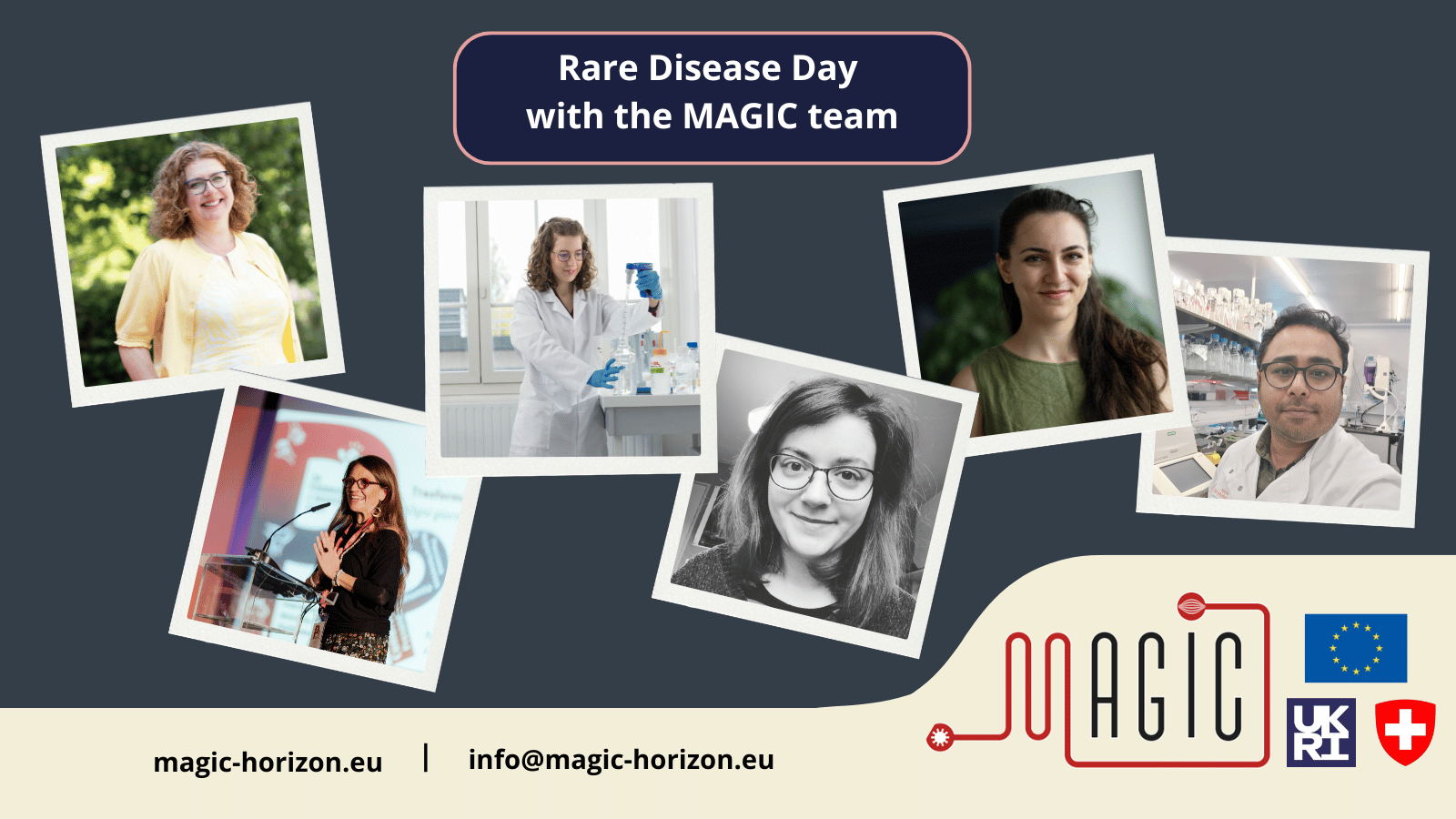
Rare Disease Day is observed every year on 28 February. It was established and coordinated by EURORDIS in partnership with over 70 national alliance patient organisations to spotlight the 300 million people worldwide living with a rare disease, their loved ones and caregivers.
This year’s theme is equity – recognising that people living with rare conditions often face unfair barriers in diagnosis, treatment, research participation, access to care and representation. The MAGIC project believes in a world where care, research and treatment pathways are built to include everyone, no matter their condition.
To reflect that theme, we asked some of our MAGIC partners a key question:
What motivates you to work in rare disease research, and how do you hope your work will help create a fairer future for people living with rare conditions?
Their answers show the power of collaboration, personal motivation, and scientific ambition, all driving toward a more equitable future.
“I have been involved in the Telethon French charity event from a young age, and have witnessed the constant improvements of gene therapy for rare diseases over decades, from gene discovery to clinical trials. I share MAGIC’s goal of making more treatments available for people with rare diseases. I am currently testing new gene therapy vectors in 3D muscles in a dish, to analyse their therapeutic potential in LMNA-related congenital muscular dystrophies (L-CMD).”
Mathilde Sanson – King’s College London
“What motivates us is the chance to turn promising research into something that can truly make a difference for people living with muscular dystrophy. As a CDMO supporting the MAGIC project, we contribute our process development expertise to help move therapies closer to patients. Being part of such meaningful work at the forefront of rare disease research is something we’re genuinely proud of.”
Isabelle Ringhofer – Dinamiqs
“People with neuromuscular conditions still face huge unfairness in diagnosis, care, and treatment, and that’s what motivates me to work in this field. The research being done by our colleagues in the MAGIC consortium shows how smarter collaboration and faster pathways from discovery to clinic can give hope and change that experience for patients.”
Kate Adcock – Muscular Dystrophy UK
“I am driven by the possibility of giving hope to patients with Duchenne muscular dystrophy who currently have no therapeutic options — something truly priceless. Through my work in MAGIC, I aim to help close key gaps in testing new genome‑editing–based therapies for this severe condition.”
Delphine Leclerc – Généthon
“Having worked in translational research for genetic diseases and having had opportunity to know and interact with people living with rare conditions, I’m driven by the urgency to help bridge the long, difficult path from discovery to real treatments. In our MAGIC work, we are developing human iPSC‑derived “mini‑organs” to better predict how will therapies behave in muscles, the heart, and the liver. By testing therapies directly on patient‑specific biology, we hope we can uncover risks earlier, build confidence faster, and ultimately speed safe, effective treatments to the clinic. For people living with rare conditions and their families, every day matters—and this work aims to make that future fairer and sooner.”
Sumit Garai – The Francis Crick Institute & University College London
“As a patient representative of the Duchenne muscular dystrophy community, I know that for families affected by this condition, every day counts. Through MAGIC’s collaborative effort to develop and safely advance next-generation therapies, we work to ensure the patient voice shapes innovation, so that promising science translates faster into treatments that truly matter for our community.”
Ilaria Zito – Parent Project aps
More information and materials on Rare Disease Day can be found here: https://www.rarediseaseday.org/


